Updated: 4 November 2026
Google Search Console helps you investigate whether Google can discover your pages, which URLs it indexes and how those pages perform in search. The useful starting point is a specific question, not a target of making every report green.
Use this workflow when an important page is missing from search, impressions change or clicks decline. Keep a record of the URL, report date, evidence and action so that you can distinguish a new problem from an old report.
Step 1: Confirm the Property and the Page You Want Indexed
Open the property that covers the exact URL you are investigating. Check the domain, protocol and preferred URL version before drawing conclusions from an empty report. Write down what the page should do for the business: explain a service, answer a question or help someone choose a product.
For a missing page, begin with URL Inspection. For a traffic decline affecting an indexed page, start with Performance. Our guide to finding the real SEO audit bottleneck explains how to prioritise these different problems.
Step 2: Compare Performance Before Changing Content
In the Search results Performance report, select comparable periods and filter to the affected page. Review queries, devices and countries before assuming a sitewide decline. Clicks measure search visits; impressions measure appearances; CTR is clicks divided by impressions. Average position is an aggregate, not a fixed ranking every person sees.
- Impressions rising but clicks flat: examine the queries gaining exposure and their positions before rewriting the title.
- Clicks falling on one page: compare its query mix and search intent, then check whether a different URL is appearing.
- A short-lived change: check date completeness and seasonality before treating it as a lasting trend.
Use Google's Performance report documentation for metric definitions. Keep search visibility separate from enquiries: Search Console does not establish how many visitors became customers.
Step 3: Separate Expected Exclusions from Indexing Problems
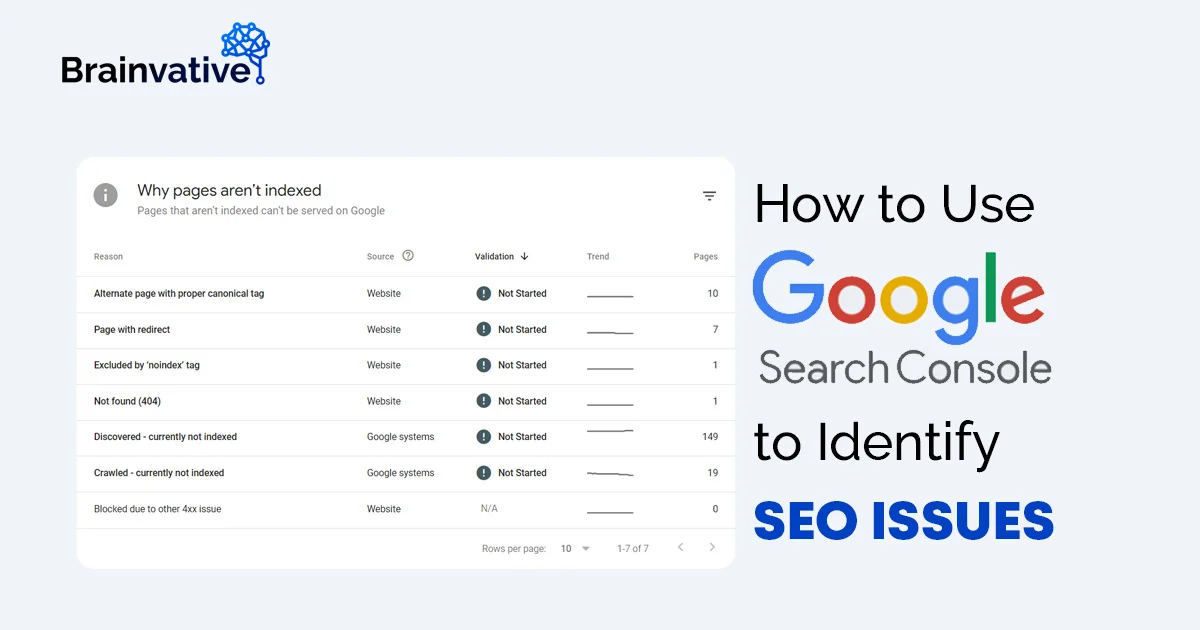
The Page indexing report groups URLs by status. Not every excluded URL needs fixing: duplicates, redirects and intentionally removed pages may correctly stay out of the index.
- Discovered - currently not indexed: Google knows the URL but has not crawled it yet. Check discovery routes and relevant internal links.
- Crawled - currently not indexed: Google fetched the page but has not indexed it. Review usefulness, overlap with other content and technical signals; the label alone does not identify the cause.
- Alternate page with proper canonical tag: confirm that the preferred version is the intended one rather than trying to index both.
- Excluded by noindex: establish whether exclusion is intentional before changing the directive.
Choose representative important URLs for individual inspection. Do not treat the report's examples as a complete inventory of every available page.
Step 4: Distinguish Indexed Data from a Live Test
In URL Inspection, record the last crawl, fetch result, crawl permission, indexing permission and canonical information. Then use Test Live URL to check the current page after a change.
The indexed report and live test answer different questions. A successful live test is not proof of indexing and cannot predict Google's eventual canonical choice. Google explains these limits in its URL Inspection documentation.
Practical example: if you remove an accidental noindex today, an older indexed report may still describe the previous version. Verify the current directive, request indexing after the fix and later check whether the crawl date advances. Repeated requests are not a substitute for resolving the underlying issue.
Step 5: Check Canonicals, Internal Links and HTTP Responses
Compare the user-declared canonical with Google's selected canonical where available. Link internally to the preferred URL and include that version in the sitemap. Avoid conflicting signals, such as linking to one version while declaring another as canonical. See Google's canonicalisation guidance.
A relevant link from an existing article can help readers discover a useful supporting page. It should explain why that destination is worth visiting, not repeat a keyword across unrelated posts. Our SEO checker can support page-level checks, but it does not replace Google's indexing record.
Handle HTTP responses according to the page's purpose. Restore an accidentally missing page if it should exist. Use a permanent redirect when there is a genuine replacement. A permanently removed page without a replacement can correctly return 404 or 410; do not redirect every missing URL to the homepage. A 200 response alone does not guarantee indexing. Google's HTTP status guidance explains the distinction.
Step 6: Review Current Page Experience Signals
Use the current Core Web Vitals metrics: Largest Contentful Paint (LCP) for loading, Interaction to Next Paint (INP) for responsiveness and Cumulative Layout Shift (CLS) for visual stability. INP replaced FID in March 2024.
Do not look for the old Mobile Usability report: Google retired it in December 2023. Its page experience update documents both changes. Still test your page on a phone: read the text, use navigation, complete forms and check for overlapping elements. For practical improvements, see website speed and performance checks.
Step 7: Investigate Links and Explicit Warnings Carefully
Review internal links for important pages that are difficult to reach. Check Security Issues and Manual Actions when investigating explicit Google warnings, rather than treating every traffic dip as a penalty.
Do not routinely disavow links because a third-party tool labels them toxic. Google says most sites do not need the disavow tool and warns that incorrect use can harm performance. Follow its disavow guidance only when the stated conditions apply, including a manual action or a likely one caused by unnatural links.
Step 8: Record the Fix and Check the Outcome
Maintain a short action log: affected URL, observed problem, supporting evidence, change made, date and next check. Verify the live result before requesting indexing. Later, check crawl and indexing status separately from clicks and impressions.
For example, correcting a canonical is a technical change; seeing Google select the intended URL is a separate outcome. Higher traffic is another outcome again. Keep those milestones separate so an accepted indexing request is not reported as a ranking improvement.
Turn Reports into a Focused SEO Plan
Prioritise important pages with a clear purpose and a specific fix. Avoid rewriting every article or changing URLs simply because a report contains exclusions. Improve one issue, verify it and record what happens next.
For help connecting technical findings with content priorities, explore our SEO services. The aim is a useful, accessible website supported by evidence, not a promise that every URL will be indexed.